THE INDIAN LUXURY PARADOX

The Global Luxury Supply Chain has a hidden inefficiency.
Walk into any high-end boutique in Paris or Milan, examine the embroidery on a $5,000 garment, and there is a high probability that the craftsmanship originated in India. We manufacture for the world’s biggest luxury houses. We provide the labor, the raw materials, and the heritage techniques that justify premium pricing.
Yet, we do not own the Intellectual Property.
This observation has driven my recent work, bridging my background in Industrial Product Design at Central Saint Martins with the business strategy focus at Mesa School of Business. When you look at the unit economics of luxury, a stark realization emerges:
India is capturing the wage, but the West is capturing the value.
The question that dictates my thesis is simple:
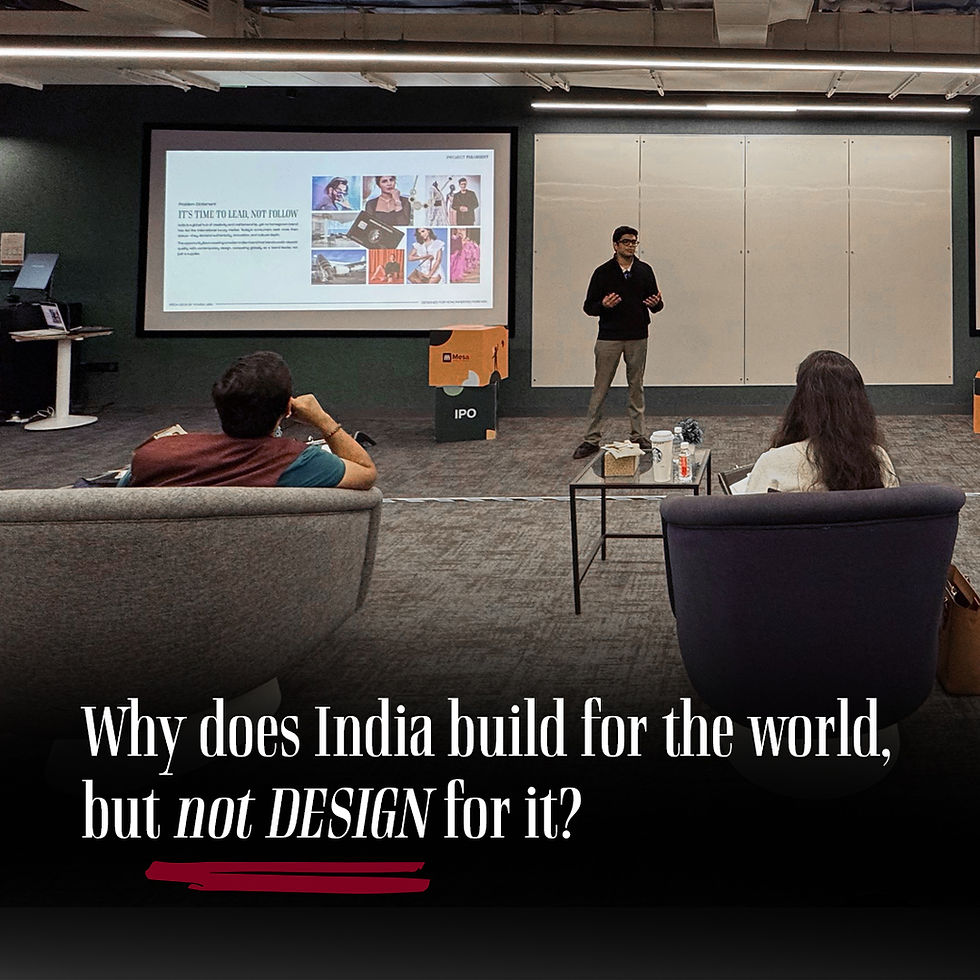
Why does India build for the world, but not design for it?
We have the craftsmanship. We have the manufacturing infrastructure. We have a centuries-old heritage of luxury. So, what is missing? Why do we not have a homegrown brand that stands shoulder-to-shoulder with LVMH or Kering?
The "OEM" Trap
For decades, Indian industry has optimized for being the world's back office. We focused on "Contract Manufacturing" (OEM)—competing on cost, speed, and efficiency. While this built a robust industrial base, it trapped us in the lowest margin tier of the value chain.
Real leverage—and real margin—exists in Brand Equity and Design IP.
The Strategic Pivot
The next decade of Indian business cannot be about building more factories. It must be about building Brands.
To bridge this gap, we need to move from being Service Providers to IP Owners. This requires a fundamental shift in capital allocation:
Investing in Design: Moving beyond functional manufacturing to aesthetic leadership.
Controlling the Narrative: Telling the story of Indian luxury, rather than letting European brands tell it for us.
Operational Excellence: Marrying our manufacturing prowess with world-class distribution and customer experience.
The Path Forward
I am writing this to explore this specific intersection: Where Design meets Unit Economics.
We are uniquely positioned to disrupt the global luxury market, but only if we stop settling for the factory floor and start aiming for the boardroom. It is time to stop building for the world and start designing for it.


Comments