The New Socio-Economic Agreement?

To what extent corporations can be profitable while aiming for a sustainable world?
“Anyone who thinks that you can have infinite growth in a finite environment is either a madman or an economist” — Kenneth E. Boulding
Every parent knows how exasperating children can be with their constant questioning, “Why?” At one moment or another, all parents have retreated behind the authoritarian “Because I said so.” On the other hand, for the designers, asking “Why?” is a prospect to reframe a problem, redefine the constraints, and open the field to a more innovative answer. Regrettably, today we are facing multiple emergencies and do not have time. Hence, it is only fair to ask why businesses need to step up; that is, what is the burning platform?
We, beings, have created a remarkable and brutal contraption, capitalism, to trade goods and efficiently meet supply and demand. The machine has generated exponential growth and raised hundreds of millions of individuals out of poverty. But it has also brought about existential catastrophes that endanger humanity. Our current economic system has two fundamental failings: it is based on unlimited growth on a limited planet and profits a small number of people, not everyone. Neoliberal policies have meant that income inequality has increased in most countries since the 1980s. Capitalism is a competing system. Innately, there will always be winners (the rich) and losers (the poor).

One significant effect of neoliberalism is a growing misunderstanding of the purpose of business organisations in general. Revenue became the purpose rather than the creation of material goods or services. The economic, environmental, social, and political challenges of the rest of the 21st century will make compliance with capitalism imperative. However, there are possible alternatives to conventional models of capitalism. Through this article, I will discuss different business models/strategies to discover the fundamental values and practices to achieve a “net positive” socio-economy and understand how corporations can still be profitable while striving for a sustainable world.
What is Net Positive?
A net positive business provides for others. It acknowledges moral perimeters for how we treat each other and tries to repair, restore, reinvigorate, and regenerate. Paul Polman and Andrew Winston, in their book ‘Net Positive’, explain this concept as a vision where a business enhances the well-being of everybody it touches and at all scales; every product, enterprise, region, and for every stakeholder, including communities, customers, employees, supplier, and even forthcoming generations and the planet itself.

What is our goal?
“Sustainability”, everyone is currently using this term, but what do they essentially mean? The United Nations Brundtland Commission defined sustainability as “meeting the needs of the present without compromising the ability of future generations to meet their own needs”. Similarly, the term ‘Utopia’ denotes a static state of social and political precision: humanity when it had become as good as it possibly can get. Predominantly, when we talk about a sustainable world, we refer to a utopian world, i.e., narrow-mindedness to a proposal of good and evil. Today’s bleak capitalism, tomorrow’s humane socialism; today’s extractive materialism, tomorrow’s ecological contentment. Questionably, just like Utopia, Eutopia also stands from similar problems; it’s ultimately impossible, it is static, and what some may deem as “good” some may find “bad”.
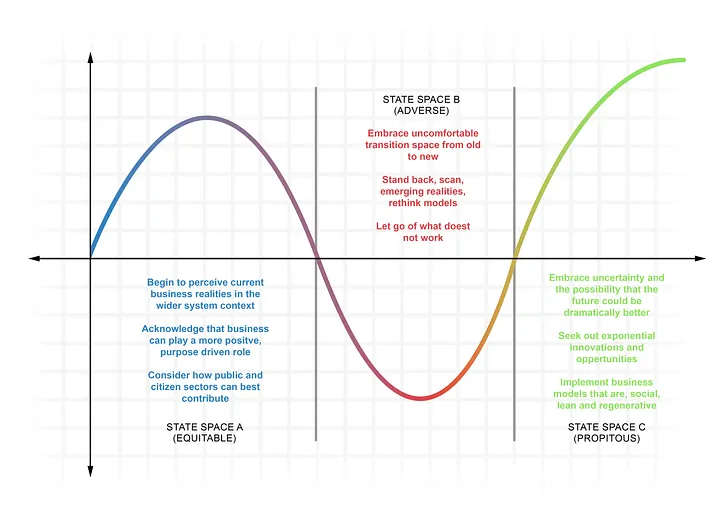
As Utopia is nothing but a mirage. One that has been plausible and perhaps previously necessary, but an illusion in the distance, no less. So, the question is, what is our goal? What are we aiming for? I thus contend that Protopia, correctly understood, denotes the gradual improvement of humanity over time; without claiming to wither perfection or reaching a point of stability. Futurist Kevin Kelly, who devised the concept of Protopia, defined it as “a state that is better than today and yesterday”. It is not the steady (linear) improvement of humanity annually, but an improvement of humanity’s ‘state space’. A change of which state humanity can enter into as it progresses, adverse and propitious states included. Hence, I believe that Protopia is the “vision”. It not only supports one future but the whole event outlook of all probable futures.
A New Economy?
Today we live in an economy which is devastatingly linear. Ken Webster, one of the founding team members of the Ellen MacArthur Foundation and the writer of ‘The Circular… Flows’ explains in his book that mainstream economics assumes we are selfish, perfectly calculating about our desires, and logical decision-makers. Linear economy, with its jumpstarting money cycle, period upon period, showed the vast advantages of what is very much an economic machinery which takes in resources, materials, and cheap energy and uses them to produce and feed mass production and consumption (and throwaway) humanity.
Ken and Ellen MacArthur Foundation suggest that the concept of circular economy, built on the study of non-linear, specifically living systems, is the solution to our problems. It is a global economic model that gradually decouples economic development and expansion from the consumption of finite resources. The circular economy is governed by two distinctively distinct types of resources: Loop 1 in the graphic is about the service-life extension of manufactured capital and resource sufficiency in reuse. Loop 2 is about material effectiveness in recycling materials.


To further elaborate, when compared to the linear manufacturing method, in a circular economy, the input of labour is higher as; first, its economics of gage is restricted to volume and geographic terms, and second, remanufacturing includes added steps of disassembly, cleaning and quality control, which are absent in manufacturing. Henceforth, the circular economy encourages us to create more jobs, care, and keep ownership of goods for future resource security. Another objective of this economy is to sustain the value, quality and performance of the general welfare, stock, and wealth. Lastly, maintaining ownership of their commodities and resources over their products’ complete life gives businesses a tremendous future price guarantee and resource security in times of escalating resource prices.
“The goods of today are the resources of tomorrow at yesterday’s prices”. — Walter R Stahel
Let us take a step back and compare these two models, linear and circular, with our vision for a moment. The linear economy model’s structure itself entails some kind of Utopia, some kind of endpoint, constantly present in the worldview itself, although one always disappearing into the distance. On the other hand, the circular economy model, in my opinion, resembles the idea of Eutopia. It does direct us to the “the good place”, but it is suitable for the specific majority and bad for others. Although, unlike Utopia, Eutopia and the linear economy, it is not static; however, it is somewhat impossible to achieve, as mentioned earlier.
Since the two most considered models in our industry are not aligned with our vision of ‘Protopia’, we need a more progressive economic model to work towards our goal. This is where the idea of ‘Net Positive’, also known as ‘Regenerative Capitalism’, comes in. Regenerative capitalism offers solutions for futureproofing, allowing brands to undertake the climate crisis while maintaining the business. It is an economical approach that regenerates instead of extracting and exploiting. It encourages companies to think past carbon neutrality and focus on a vision that regenerates the environmental, social, and economic systems it depends on, explains John Elkington, a global authority on corporate responsibility and sustainable development.

Further, ‘John Elkington’ in his ‘Principles of Generative Capitalism’, explains that consumers and businesses are part of an “interconnected web of life”, and they count on nature to endure and flourish. As our vision, this model also opposes the idea of perfection; rather, its theory states that no brand can accomplish all these aims at once, but allows us to enter into a change state if we want a viable planet and economy. To exist as a pertinent company today is to improve the world. Hence, unlike linear and circular, this model forces brands to shit their mindset from extractive to regenerative, rethinking their business purpose, products, and operations. In his book “Net Positive,” Paul Polman claims, “Companies pursuing this model are better positioned for the future and ultimately more successful.”
A Map of ‘Vision’
The pragmatic dangers of inequality and climate threats have gotten exponentially worse. Nobody is coming to rescue us. We failed it; we own it. So, just achieving operational targets, such as cutting carbon emissions, will not work. This is why the idea behind regenerative capitalism is to help corporations translate themselves, so they reach those big targets as a natural plan of doing business. The following are core principles and strategies of the regenerative economy, which are also discussed in the book Net Positive and will help us build new kind of organisations that serves the world. We can use these principles and strategies as a map towards our vision.
Responsibility is a core divider between a typical business and a “net positive” one. Obviously, companies and corporations cause environmental harm, but the problem is when they don’t take liability and are not inquiring about how to limit the damage.
According to the book Net Positive’, the following are the five notions that focus on responsibilities to take the company’s operations towards our vision.
1) Ownership of all impacts and consequences, intentional or not
Stakeholders are forcing corporations to internalise their environmental and social impacts. It is high time to proactively say “we own” everything that occurs with our suppliers, our customers, and at the end of the life of our products. In our vision, we need to own the impacts of our businesses from the deep supply chain to the end of the product’s life. Acknowledging everything shifts the ethos and focus of the company, making it more being.
2) Performing for the long-term value of society and business
Short-term thinking will not allow us to emerge from the deep collaboration and systemic thinking we need. Shooting for the moon in a given period does not mean creating long-term value; instead, benefiting from consistency over time by investing every year in the compounding effects. The point is not to develop a strategy for what the company does for the next decade or two. Instead, think about the personal and corporate morals that won’t change. How do you support creating a thriving world? What is the purpose?
3) Generating positive revenues for all stakeholders
Stakeholders who do not have a seat at the table also need a solution where everyone benefits for the coming generation and the planet itself. This principle is at the core of our new economic model of providing for others. Improving lives and healing the earth by innovating and offering new products and services. Or by building a diverse, inclusive business while assisting employees in finding their purpose and enhancing their lives. Or helping suppliers make their companies more efficient and sustainable. Or simply assisting neighbourhoods to thrive.
4) Steering shareholders’ value as a result, not a target
Peter Drucker said, “Profit for a company is like oxygen for a person. If you don’t have enough of it, you are out of the game. But if you think life is about breathing, you are really missing something.” Profit is not a purpose but an end product.
5) Partnering to drive systemic transformation
The more significant system shifts can only occur in partnership with parties outside of a corporation’s power, society members, NGOs, consumers, government, suppliers and more. Policies can create contradictory consequences or be ineffective if there is no mandatory structure to stop free riders.
The broader idea is to give your corporation a soul. There is nothing more potent for an establishment than getting to the heart of why it exists and then making that aspiration come alive. From the Oxford Business School, Colin Mayer states, “the purpose of business is to solve profitability and not to profit from causing or exploiting problems”. In simpler words, he also believes “give more than you take”. In the long run, everything about the business should adapt around delivering this purpose. As a result, purpose pays off. In the book, Net Positive’Paul mentioned that the JUST Capital 100, a list of businesses rated highly on serving society and purpose in five years, produced 56% higher total returns for their shareholders. Further, a study from Deloitte showed 40% higher levels of employee retention and 30% higher levels of innovation for mission-driven companies.
There are many inspirational purpose statements, such as:
· Unilever: “To make sustainable living commonplace”.
· Tesla: “Accelerate the world’s transition to sustainable energy”.
· IKEA: “Create a better everyday life for the many people”.
· Timberland: “Equip people to make a difference in the world”.
Additionally, having a purpose leads to building a long-term emotional connection with the customers. Denise Lee Yohn explains in his book “What Great Brands Do” that great brands avoid selling products. They use these emotional values to differentiate their offerings and connect with consumers. He also states that long terms customers with emotional connections are far more valuable than short-term sales. The best case study for this theory is the brand ‘Nike.’ Few brands are as diligent in associating products with emotions as Nike. As ‘Scott Bedbury’ the American consultant said “Just Do It” was not about sneakers. It was about morals. It was about the brand ethos and never about products. The “Just Do It” ad campaign ran for about a decade and is a crucial example of how selling emotions prevail over selling products.

The product offers the customer access to their self-identity that they want to experience and express, “I am an athlete”, or fulfils an emotional necessity they have, “I want to feel healthy and successful”. For instance, let us compare Nike’s and Adidas’ (a leading competitor) ad campaigns in 2012 during the London Olympics. Adidas ran high-voltage, entertaining sites that emphasised their products. In contrast, Nike made an emotive bond through a new call to action, “Find Your Greatness”, which was quiet and moving. Although Adidas had paid $115 million to be the official sportswear partner of the Olympics that year, Nike’s ads produced fifteen times as many internet dialogues as Adidas’s.

Furthermore, the idea of being “net positive” demands use to set uncomfortable goals. If it is achievable, it is not big enough. A clear sailing path is not really a goal; it is an action plan. Missing a few percentages while shooting for the moon is far better than beating a target with incremental improvement. It is also more motivating. A big enough target will be challenging to accept, but it will drive new thinking. Tim Cook rightly wrote, “The planet we share can’t wait…” and announced that Apple will go carbon neutral by 2030. Yet another excellent example of pushing the boundaries is what Tesla is doing. The push has come in various forms, from carbon dioxide emission limits for passenger cars to purchase price grants, tax immunities, infrastructure development, and technology advancements.
Tesla not only stirred the well-established automotive manufacturers but shook them. Elon Musk is a tycoon who imagines big and bets big. Tesla’s mission, he says, is to accelerate the world’s transition to sustainable energy. To achieve that target, he knows that Tesla must produce electric automobiles in enough volume to force a fundamental change in the automobile industry. One prospective obstruction: with a proposed manufacture rate of 500,000 cars a year in the latter half of this decade, Tesla alone will require today’s global production of lithium-ion batteries. So, the Gigafactory is a being of inevitability.

Ultimately, there is a need for regenerative advocacy and a system-level reconstruction. We cannot deal with global threats by working with an individual company or even one sector at a time. The concerns know no borders and demand unparalleled collective action to resolve them. Compelling solutions need all three pillars of humanity, civil society, the public sector, and the private sector, to work simultaneously. Corporations usually use two means to influence and create the outcomes they want: lobbying and corruption. The distinction between the two is often one of semantics. The goal here is to add the component of moral power and turn the entire procedure towards a better outcome. In this new model, businesses will put the needs of a community, region, or country first and strive for policies that resolve challenges for all. Alliances between governments and companies are not simple. Adding elements of civil society makes it even more sophisticated and eventually prosperous. We need to have a partnership that, for example, works on the following:
Guide policy to facilitate regenerative results, such as working on incentives for more ecologically friendly packaging and recycling or stepping up specific climate change regulations.
Push policymakers to think big, with adequate support making it clear where business meets on matters like climate change.
Take on the major societal problems, such as the extremely problematic palm oil production system that ties into climate change, disparity, and most other global disputes.
Help countries prosper through public-private alliances in ways that strengthen economic development and develop new divisions or expand business ecosystems.
Goals like these will help develop partnerships and advise all stakeholders on the correct conclusions. These collaborations will pay off immensely for both society and corporations. Private organisations, along with government entities, are capable of creating more broader impacts. In order to take more responsibility, corporations need to work towards creating Scope 6 values. Paul, in his book, mentions these as scopes and shares six impact levels with the diagram below.

This will also enable us to rethink our measures and structures of success. Today, how we view growth is deeply flawed. Shareholder value and stock prices are focused for companies, and we obsess over the gross domestic product (GDP) at the macroeconomic level for countries. We need to evaluate what we deeply appreciate. There are various substitute measures for an economy.
UN’s Human Development Index incorporates life expectancy, education, and income levels.
Happy Planet Index, which makes up a principle of well-being, reduced inequality, and life expectancy, is divided by ecological footprint.
Genuine Progress Indicator looks at a country’s performance on broader economic, social, and environmental variables.
Gross National Happiness, sustainable development, good governance, environmental conservation and preservation and promotion of culture.
We need to think well beyond minimal requirements and distribute more expansive lists of determines of success in classifications such as prosperity, including health and well-being, people of governance, planet, and people.

Lastly, change is occurring more rapidly, more profoundly, and across more sectors than ever. Consumers are having a rising impact on retail and strategy. The power that customers have over business outcome-making is also shifting. The individual is becoming more potent. New consumer behaviours are revising the way brands do business. In his book “The Next Big Thing”, William Higham claims that corporations that distinguish, evaluate, and employ trends appropriately can gain immensely increased sales and a significant competitive lead. But I beg to differ as this ideology does not support our vision.
Instead, I agree with Denise Lee Yohn, who, in his book, suggests that great businesses disregard trends because they are reluctant to renounce their company ethos and emotional connections with consumers to the impulses of the market. Eventually, by stimulating trends and beginning movements of their own, businesses give their customers more prospects to connect with them. The commitment to disregard trends turns corporations’ conversations about innovation and expansion back to where they belong, driven by their ethos and emotional links with their customers. After all, “culture is the glue”, as Paul also talks about in his book. It is vital that in this voyage of regenerative capitalism, values and company ethos are inherently underpinning an establishment. They should hardly shift, if ever.
Basic Regenerative Economy Model:
As of today, there is no distinct visual representation of ‘Regenerative Economic Model’, at least non that I came across during my research. It is often represented as an extension of the circular economy model; however regenerative economy is more than a closed loop.
The model is dynamic and allows us to grow and re-think our approach, as mankind reaches different stages with time. This model can be further developed with a more collective approach in order to perfectly reflect the new economic model.
The Choice is ours!
According to John Della Volpe, Harvard University’s polling director, the upcoming generation “are not rejecting the concept” of capitalism; instead, “the way in which capitalism is practised today” is what they are discarding. The majority believes it is unfair. Hence, regenerative capitalism and net-positive businesses are of utmost importance. Its fundamental nature is the notion of business as a drive for good, using associations, power, and resources to benefit all.
The remarkable thing is that the pressure is on. We need to fight through some biased perceptions and enduring illusions, such as we cannot produce with no waste, inclusion and diversity goals unattainable as there are not sufficient trained people of colour, or renewables are too expensive. All mistaken! Humankind has numerous of the answers and technologies it requires, it is packed with entrepreneurs and problem-solvers to shape out the remainder, and there is plenty of capital out there. This also implies that business thinking shares common intellectual ground with design thinking. Businesses can apply design thinking to attain extraordinary, inventive, and culturally significant outcomes. Creative design thinking offers innovative ways of advancing a problematic circumstance and the skill to solve them ingeniously, insightfully, and for the greater good. Innovation management, creative industries, and design thinking can be linked to benefit each other for socio-economic success.
Ultimately, we have a choice between slower development, unyielding borders, less prosperity and widening inequality or inclusive growth, the rise of a reconnected world, more robust businesses and a surge of innovation and efficiency. We can choose what kind of world we create and in which direction we walk. Already, the gallant group of leaders stepping in the right direction is expanding. All we need is more faith, more daring, and more compassion. The rewards are vast, for us, for businesses, which will allow us to prosper in a whole new way, for all of us living together on this whirling, fallible ball. All we need to ask ourselves is:
“Is the world better off because your business is in it? — Paul Polman
Work Sited
1)Brown, T. and Kātz Barry (2019) Change by design: How design thinking
transforms organizations and inspires innovation. New York,
NY: Harper Business.
2)Field, J. and Taylor, M. (2018) Is capitalism working? Thames & Hudson Ltd.
3)Julier, G. (2017) Economies of Design. Los Angeles: SAGE Publications.
4)Junginger, S. and Faust Jürgen (2016) Designing Business and Management.
London: Bloomsbury Academic.
5)POLMAN, P.A.U.L. (2022) Net positive: How courageous companies thrive by
giving more than they take. S.l.: HARVARD BUS REVIEW PRESS.
6)Webster (2017) The circular economy: A wealth of flows. 2nd edn. Cowes:
Ellen MacArthur.
7)Yohn, D.L. (2014) What great brands do: The Seven brand-buliding principles
that separate the best from the rest. San Francisco: Jossey-Bass a Wiley Brand.
8)Penty, J. (2020). Product design and sustainability : strategies, tools and
practice. London: Routledge, Taylor & Francis Group.
9)Elkington, J., Lim, J. and Smith, L. (2016) Breakthrough Business Models
Exponentially more social, lean, integrated and circular. rep. London: Volans.
Available at: https://volans.com/wp-content/uploads/2016/09/Volans_Breakthrough
-Business-Models_Report_Sep2016.pdf (Accessed: 2022).
10)“Progressive Capitalism: Redefining Brand Values” (no date). Available at:
https://www-wgsn-com.arts.idm.oclc.org/insight/article/78237#page_1
(Accessed: 2022).
11)Rocca, M. (2022) Emerging Concept: Regenerative Capitalism, University of
the Arts London weblogin. Available at:
https://www-wgsn-com.arts.idm.oclc.org/insight/article/93547
(Accessed: October 2022).
12)Crowell, M. (2020). The Road to Regenerative Organic CertifiedTM.
[online] Patagonia Provisions. Available at:
https://www.patagoniaprovisions.com/blogs/stories/the-road-to-
regenerative-organic-certified.
13)Freinacht, H. (2022). What’s The Difference between Utopia, Eutopia, and
Protopia? [online] Medium. Available at: https://medium.com/@hanzifreinacht
/protopia-beyond-utopia-8200a20b2c43 [Accessed Nov. 2022].
14)Nestlé Global. (n.d.). Regenerative agriculture. [online]
Available at: https://www.nestle.com/sustainability/nature-environment/
regenerative-agriculture.
15)Unilever (2020). Strategy and goals. [online] Unilever. Available at:
https://www.unilever.com/planet-and-society/raise-living-standards/strategy-
and-goals/.
16)United Nations (2022). Sustainability | United Nations. United Nations.
[online] Available at: https://www.un.org/en/academic-impact/sustainability
[Accessed Nov. 2022].


Comments